Paper Theater: What a Public Journal Club Taught Us About Explaining Science
The Format: From Seminar Room to Library Stage
The ordinary journal club is a useful instrument. It trains students to read methods, challenge claims, and practice criticism among peers. It is also, by design, closed. The audience already shares a vocabulary, and the presenter can assume that everyone knows why a control matters.
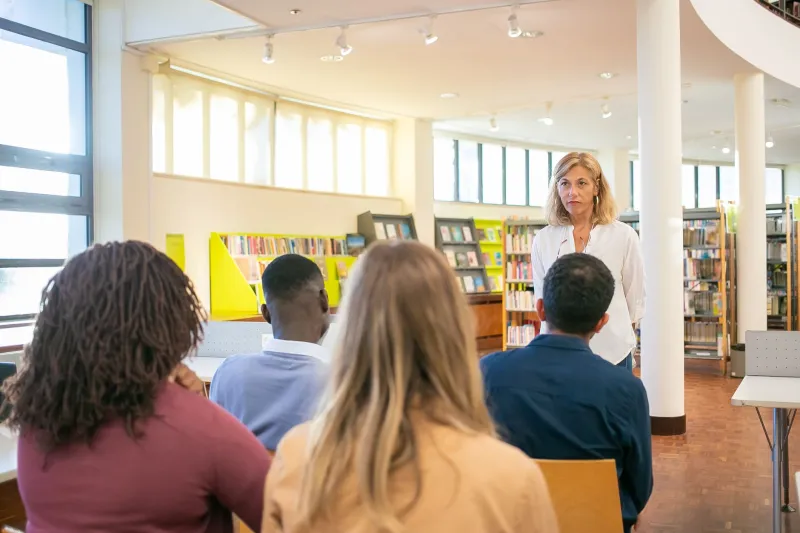
A public paper theater inverts those assumptions. In a pilot series held in a public library meeting room, with a parallel campus session for students, the basic structure was simple: a seventy-five-minute event built around one paper, one presenter, and one visible piece of evidence. The first ten minutes established why the question mattered. The next twenty-five minutes walked through the study design and the main figure. A short demonstration or data-reading exercise followed. The final twenty-five minutes belonged to questions.
The format was not a lecture and not a debate. It was closer to a guided reading. The presenter used a small number of slides, usually one figure per slide, and kept jargon to a minimum. A handout included the paper citation, a glossary of three terms, and a short note on limitations. Attendance was modest, generally between twenty and forty-five people, but repeat attendance was high. The audience included retirees, library staff, high school teachers, undergraduates, and a few working scientists.
Choosing Papers Without Turning Them Into Hype
Paper selection is the most consequential editorial decision. The goal is not to find the most dramatic result. The goal is to find a paper that can be explained honestly in public.
A useful screening rule is to prefer studies with a clear question, a readable design, and a modest claim. Papers that depend on a press release for their significance are poor candidates. Papers that report a single striking number without accessible methods are also difficult. The best choices often include a replication, a null result, or a study with an obvious limitation that the audience can understand.
The presenter should state the claim in plain language, then state what the study did not show. If the paper reports an association, say so. If the sample was small, say so. If the authors used a proxy measure, explain what the proxy does and does not capture. This is not a concession to simplicity. It is an exercise in precision.
A second rule is to pair the paper with context. One short commentary, a replication attempt, or a methods primer can prevent the event from becoming a celebration of a single finding. The audience should leave with a sense of how the evidence fits into a larger literature, not with the impression that one paper settles a question.
Training Presenters to Say 'We Do Not Know'
Student presenters needed more rehearsal than expected, but not for the reasons one might assume. The challenge was not simplifying the science. The challenge was resisting the urge to over-explain certainty.
Training sessions focused on three questions. First, what was measured, exactly? Second, what could have gone wrong? Third, what result would have changed the authors' interpretation? Presenters practiced answering these questions without defensive language. They also practiced saying, 'We do not know from this paper,' which is a difficult sentence for a trainee who has been rewarded for mastery.
The most effective presenters used the figure as a shared object of attention. They pointed to axes, explained what each point represented, and invited the audience to notice what was missing. This approach reduced the pressure to perform expertise and increased the audience's willingness to ask basic questions.
What Attendance and Questions Revealed
The pilot was not a formal study, so the observations are anecdotal. Still, the pattern of audience questions was revealing. Few questions concerned the most technical detail of the paper. Many concerned trust: How was the instrument calibrated? Who funded the study? Why should a reader believe this measurement? Others concerned practical consequences: What would this mean for a school, a clinic, or a household decision?
The questions also exposed a gap between scientific and public attention. Scientists often prepare for questions about mechanism. Public audiences often ask about reliability, incentives, and uncertainty. A presenter who can address those questions without defensiveness communicates more than one who recites the abstract.
Attendance patterns suggested that the format attracted people who would not attend a traditional seminar. The library setting mattered. So did the absence of an institutional badge requirement. The event felt like a public reading group rather than a departmental obligation.
The Costs and the Caveats
A public paper theater is not free. It requires a partner venue, a willing presenter, a small budget for printing or refreshments, and time for rehearsal. It also carries risks. A poorly chosen paper can turn a public event into a misleading spectacle. A presenter who is not prepared can create false confidence. And no public event substitutes for peer review.
The format works best when it is honest about its limits. It is a communication experiment, not a verdict on the science. It should be evaluated with the same care as any other experiment: keep a short record of attendance, collect audience questions, debrief with presenters, and revise the format.
A Model Worth Testing Elsewhere
For labs considering a similar experiment, the first step is not publicity. It is a partner. A public library, a science center, or a campus outreach office can provide a room and an audience that does not already share the lab's assumptions. The second step is a paper that can survive plain explanation. The third step is a rehearsal in which the presenter practices saying what the study did not show. The fourth step is a debrief.
The broader lesson is that public science communication is not a performance of certainty. It is a practice of making evidence inspectable. A journal club turned outward can remind researchers that the most important question is often the one a careful outsider asks first.